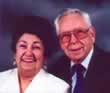
Pastors Jim and Marie Watt
2008.07.22 - WESLEY'S COVENANT PRAYER
(Excerpts from Wikipedia)
Wesley's Covenant Prayer or A Covenant Prayer in the Wesleyan Traditionis a prayer adapted by John Wesley, the founder of Methodism, for use in services for the Renewal of the believer's Covenant with God. In his Short history of the people called Methodists(1781), Wesley describes the first covenant service; a similar account is to be found in his Journalof the time. Wesley says that the first service was held on Monday 11 August 1755, at the French church at Spitalfields in London, with 1800 people present. He reports that he “recited the tenor of the covenant proposed, in the words of that blessed man, Richard Alleine”.
Service using the Covenant prayer have been included in Most Methodist books of liturgy since, though none was included in the Sunday Service of the Methodists in North Americabook that Wesley published in 1784 for the use of his followers in America. Perhaps for this reason, while the Covenant service has been an invariable part of the liturgy of the British Methodist Church and its daughter churches in the Commonwealth, its use is less widespread in American Methodist denominations. The covenant prayer and service are recognized as one of the most distinctive contributions of Methodism to the liturgy of the church in general, and they are also used from time to time by other denominations.
Although Wesley's early covenant services were not held at any particular time of year, in British Methodism the custom soon developed in holding Covenant services near the beginning of the New Year, nowadays usually on the first or second Sunday of the year. This was perhaps under the influence of a different Methodist tradition, the holding of “Watchnight” services on New Year's eve, in competition with the rowdy secular celebrations of the new year.
The form of the covenant prayer and service have been simplified since Wesley's time, but important elements of them are still retained from Wesley's Directions. They include many of the words both of the bidding that traditionally precedes the prayer, and the prayer itself. The bidding traditionally includes phrasing such as:
... Christ has many services to be done. Some are easy, others are difficult. Some bring honor, others bring reproach. Some are suitable to our natural inclinations and temporal interests, others are contrary to both... Yet the power to do all these things is given to us in Christ, who strengthens us.
THE PRAYER
I am no longer my own, but Yours.
Put me to what You will, rank me with whom You will.
Put me to doing, put me to suffering.
Let me be employed for You or laid aside for You,
exalted for You or brought low for You.
Let me be full, let me be empty.
Let me have all things, let me have nothing.
I freely and heartily yield all things to Your pleasure and disposal.
And now, O glorious and blessed God:
Father, Son and Holy Spirit,
You are mine, and I am Yours.
So be it.
And the covenant which I have made on earth,
let it be ratified in heaven.
Amen.
(as used in the Book of Offices of the British Methodist Church, 1936).
NOTE ONE. In 1947 a copy of “Wesley's Doctrinal Standards” by Burwash was deleted from the Library of St. Andrew's United Church of Canada Seminary in Saskatoon, Saskatchewan. I had the good fortune to procure this copy among many others that were discarded. It contained 52 Sermons. 49 of them by John Wesley. They were used to instruct future ministers, Sunday School teachers, Class Meeting leaders among others. Those seeking ordination had to memorize all 52 sermons, and be ready before an examining committee to preach any one of these 52. Many Bible quotations appear in each sermon -- so one can surmise how well prepared for ordination each candidate became!
These 52 sermons were arranged by John Wesley under 10 Heads -- and contained the basis of his Theological position. 13 of the 52 sermons were on the Sermon on the Mount. This was a wise choice over and above the 10 commandments, for it includes inward heart religion as well as outward moral and ethical standards.
My step-grandfather had a great influence on my life, especially the 4 years we spent on his farm during Depression Times of 1933-1937. He was a faithful leader in a large Methodist Church in Vancouver, BC. In 1925 it united with a large Presbyterian Church on Burrard Street to form St. Andrew's Wesley United Church of Canada. It was here in 1942 that I received a call to the ministry while yet an unbeliever.
The Class Meetings of Methodism formed by Charles and John Wesley had a singular effect on 70,000 of their members. Some 8 rules were weekly reviewed under a leader of some 8 members in England,Wales, Scotland and Ireland. These received regular visits by an overseer, often by John Wesley himself, who rode horseback over 50,000 miles to do so along with Chapels and outdoor preaching as inaugurated by George Whitefield, a staunch Calvinist.
An English Sociologist (an unbeliever) at the time of the close of the 18thCentury, wrote a book stating that except for the Wesleyan Methodist Class Meetings, the French Revolution of 1789 would have leaped the English Channel and brought its horrendous Guillotine to Great Britain.
“The Cure of Evil Speaking” I believe is the 49thsermon of “Wesley's Doctrinal Standards”, and in my estimation is one of the most valuable and needed words still for today.
Wesley's mother Susannah had a most valuable input into her 19 children of whom but 10 survived childhood. John was the 15th, Charles the 17th, and an older brother Samuel the only surviving boys of the 10. She spent an hour each day with one of her children, and went over carefully with each one, very fine moral standards, and led them to confess their lapses, and stood with them in achieving victory. John later on asked her to send him the various rules she shared with each of his brothers and sisters.
2